The Illusion of Algorithmic Randomness
In standard computational frameworks, randomness is an illusion created by complex deterministic algorithms. According to Dr. Thurman Richard White's research in quantum statistical mechanics, a computational algorithm lacks the incompleteness required for staging true reconstituted probability descriptions. Every pseudo-random number generator (PRNG) is, at its core, a function: given the same seed, it produces the same output. Given enough output, an adversary can recover the seed. This is not a bug to be patched — it is the defining property of software.
Modern cryptographic systems papered over this reality by relying on computational hardness: the assumption that certain operations (factoring large integers, computing discrete logarithms) are intractable for classical adversaries. The approach worked so long as the adversary obeyed the same rules as the defender. Quantum computation broke that symmetry. Once Shor's algorithm became credible, the entire edifice of mathematical cryptography acquired an expiration date.
ATOFIA's position is that the correct response is not to migrate to a new class of mathematical problem — a class that will, in turn, acquire its own expiration date — but to abandon the premise that randomness can be generated by software at all.
The Schwinger Effect & Thermodynamic Reconstitution
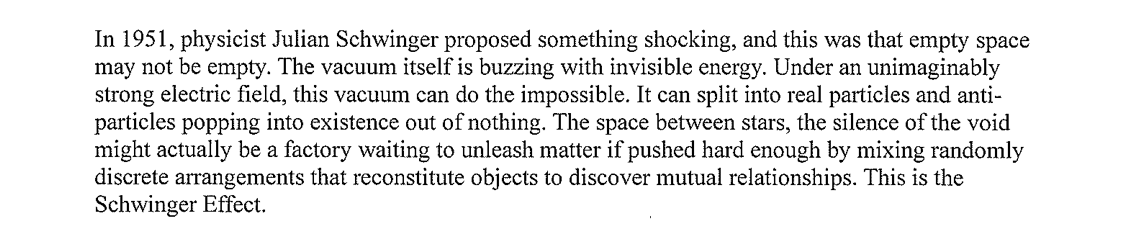
ATOFIA's technology is rooted in profound principles of physics. As physicist Julian Schwinger proposed in 1951, a vacuum is not empty; it is buzzing with invisible energy. Given a sufficient electrical field, the vacuum "splits" into observable particles and anti-particles, creating matter out of nothing. By applying the same principles of thermodynamic equilibrium to cryptographic state, ATOFIA taps into this probability cloud as a source of entropy.
Below is an extract of the mathematical mapping from the ATOFIA whitepaper denoting the thermodynamic energy baseline required for this mixing protocol:
We do not generate random numbers via equations. We utilize Thermodynamic Entropy Mixing Protocols (P+1, P−1) to initiate the reconstitution of quantized discrete mixing of microstates. The distinction matters. A PRNG produces numbers by applying transformations to a seed; given the transformations and the seed, the output is determined. A thermodynamic mixing protocol produces microstates by sampling a physical system; given the transformations and all prior observations, the next microstate remains undetermined.
"Entropy is not just disorder or randomness. The mechanical infrastructure of entropy is better explained as a reconstitution of quantized discrete mixing of new microstates." — Dr. Thurman Richard White, ATOFIA
Why Physical Sampling Beats Algorithmic Generation
Three properties distinguish physical entropy from algorithmic output:
- Non-reproducibility. No two samples of a physical thermodynamic system produce identical trajectories. An algorithm, by contrast, must produce identical trajectories given identical seeds — this is its correctness criterion.
- Non-observability. An adversary with full knowledge of ATOFIA's protocol and full observation of prior outputs cannot compute the next output. The next output is not computed; it is sampled.
- Incompleteness. By Gödel's theorem, any sufficiently powerful formal system contains true statements that the system cannot prove. A physical mixing protocol is not a formal system; it cannot be subjected to this critique.
Operating in Low Validation Environments
ATOFIA's protocols redefine how systems establish a "Trusted Anchor." By combining Clausius-Gibbs-Boltzmann-Shannon entropy formulations, ATOFIA delivers a thermodynamic bedrock of unpredictability that algorithms can never replicate.

In environments where computational validation is weak — cloud-virtualized workloads, adversarial enclaves, satellite uplinks, air-gapped deployments with no reliable hardware RNG — the thermodynamic anchor is the only remaining reference frame an attacker cannot replicate. The attacker may observe every bit of output, reverse-engineer every line of code, and mirror every microsecond of network traffic. None of these capabilities grants the ability to predict the next microstate, because prediction requires a model, and the protocol is not generated from a model.
This is the practical significance of the Schwinger Effect for cybersecurity: it relocates the source of randomness from the computational layer (where adversaries can eventually reach it) to the physical layer (where they fundamentally cannot).
Implications for Post-Quantum Cryptography
Most post-quantum cryptography (PQC) schemes — lattice-based, hash-based, code-based — retain the algorithmic premise. They substitute one hard mathematical problem for another and trust that the substitution will outlast the next generation of adversaries. This is a reasonable bet on a timeline of decades; it is an unreasonable bet on a timeline of centuries.
Thermodynamic cryptography does not require the bet. Because its randomness is sampled rather than computed, no advance in computational capability — classical, quantum, or otherwise — makes the samples predictable. The thermodynamic anchor is, in the strictest sense, future-proof with respect to computational adversaries.